
Last month I asked a local contractor a simple question: how many calls do you think you missed last week? He guessed two, maybe three. We checked his phone records together. It was nineteen. Nineteen people decided they wanted help, dialed his number, and reached voicemail. Most never called back, because the next business on Google was thirty seconds away.
I see a version of this in almost every business I look at, and it has nothing to do with the quality of the work. It is the opposite. The owners losing the most are usually the ones doing the best work, because the people best equipped to answer the phone and follow up are the same people out doing the job. You cannot be under a sink and on a call. A front desk cannot check in a patient and answer two lines. Nobody is answering at 9pm on a Saturday, which is exactly when someone’s basement floods.
So when growth stalls, the instinct is always the same: get more leads. More ads, more posts, more networking. But pouring more water into a leaking bucket does not fill the bucket. It just makes the puddle on the floor more expensive. Before you spend another dollar on marketing, it is worth finding the holes.
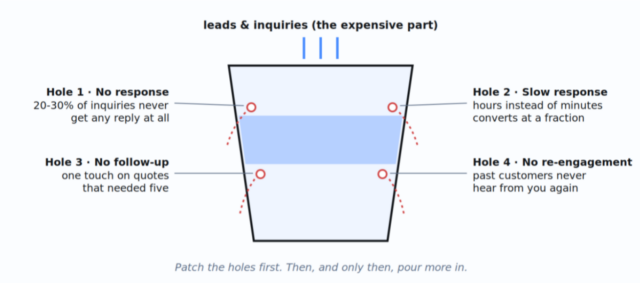
The five places revenue quietly leaks out
Every local business loses money in the same handful of places. Calls that go unanswered. Leads that get a slow response and go cold. Quotes that never get a second touch. A Google rating that quietly turns customers away before they ever call. And past customers who simply drift off because nobody stayed in touch. Each one feels small. Together, they usually add up to more than a business spends on marketing in a month.
The good news is that none of these are mysteries, and none of them require you to work harder or care more. They are systems problems, and systems problems have known fixes. The even better news: you can measure all five yourself this week, for free, and the measuring alone usually changes how an owner runs their business.
Your one-week revenue-leak checklist None of this requires new software or a single dollar spent. It just requires looking honestly at five places revenue slips out. Work through one section a day. 1. Answer every call (the floor) ✓ Call your own main line after hours and on a weekend. Listen to exactly what a customer hears. Dead air, a clumsy voicemail, or a human? ✓ Set up an instant text-back on missed calls: even “Got your message, we’ll call within the hour” beats silence. ✓ Make sure your voicemail greeting gives a callback window and a text option. 2. Respond fast (speed wins the job) ✓ For one week, log every inquiry with two timestamps: when it came in, and when a human actually responded. Calculate your average. Then check it for after-hours only. ✓ Find where your website form actually lands. If it’s an inbox nobody watches, route it somewhere you’ll see within minutes. ✓ Aim to respond to new leads in minutes, not hours. After a few hours, most leads are gone, no matter how good you are. 3. Follow up (where most revenue hides) ✓ List every quote from the last 60 days that never got a second touch. That’s revenue you already paid to generate.
✓ Send each one a simple check-in today: “Wanted to make sure my estimate came through, happy to answer any questions.” ✓ On every new quote, set three reminders: day 2, day 9, and a day-21 “should I close your file?” note. 4. Protect your reputation (it taxes everything else) ✓ Google your business and write down your exact rating and review count. Below 4.5 quietly turns away customers your marketing already paid for. ✓ Ask your five happiest recent customers for a review this week, and send them the direct link. ✓ Set a rule: every completed job or visit triggers a review request the next day. Respond to every review, good and bad. 5. Keep the customers you’ve earned ✓ Check the last time your past-customer list heard from you. If the answer is “never,” that’s the cheapest revenue you’re ignoring. ✓ For appointment businesses: add a recall reminder for customers due back, and a simple waitlist to fill cancellations. ✓ Send past customers something useful twice a year. Staying in touch costs almost nothing and brings them back.
What to do once you can see the leak
Work through that checklist and you will have something most owners never get: a clear, honest picture of where your revenue is actually going. Some of the fixes are things you can do yourself with a sticky note and a calendar reminder. Others, answering every call around the clock, qualifying leads automatically, following up with every quote without fail, are exactly the kind of repetitive work that modern systems now handle quietly in the background, for a fraction of the cost of a new hire.
The point is not to automate everything. It is to stop losing revenue you have already earned, so the time and money you spend on growth actually compounds instead of leaking away. That is the whole idea behind the work we do, and it is why the first step is always measurement, never a sales pitch.
A note for fellow chamber members: For a short time, Compound Growth Strategies is offering a complimentary AI audit to Bergen County Chamber members. It is a 30-minute working session on your real numbers, where your calls, leads, and follow-up are actually leaking, with a straight answer about what is worth fixing and what isn’t. No pitch, no pressure, and if the numbers say you don’t need it, we will tell you so. If you’d like to look into it further, you can book at compoundgrowthstrategies.com or send email to info@compoundgrowthstrategies.com.
Rediet Wegayehu is the founder and CEO of Compound Growth Strategies, which builds AI sales systems for home service pros, local practices, and appointment-based businesses, so they book more revenue, win back their nights and weekends, and never miss a lead